Spatchcock Turkey
This post may contain affiliate links. Please read my disclosure policy.
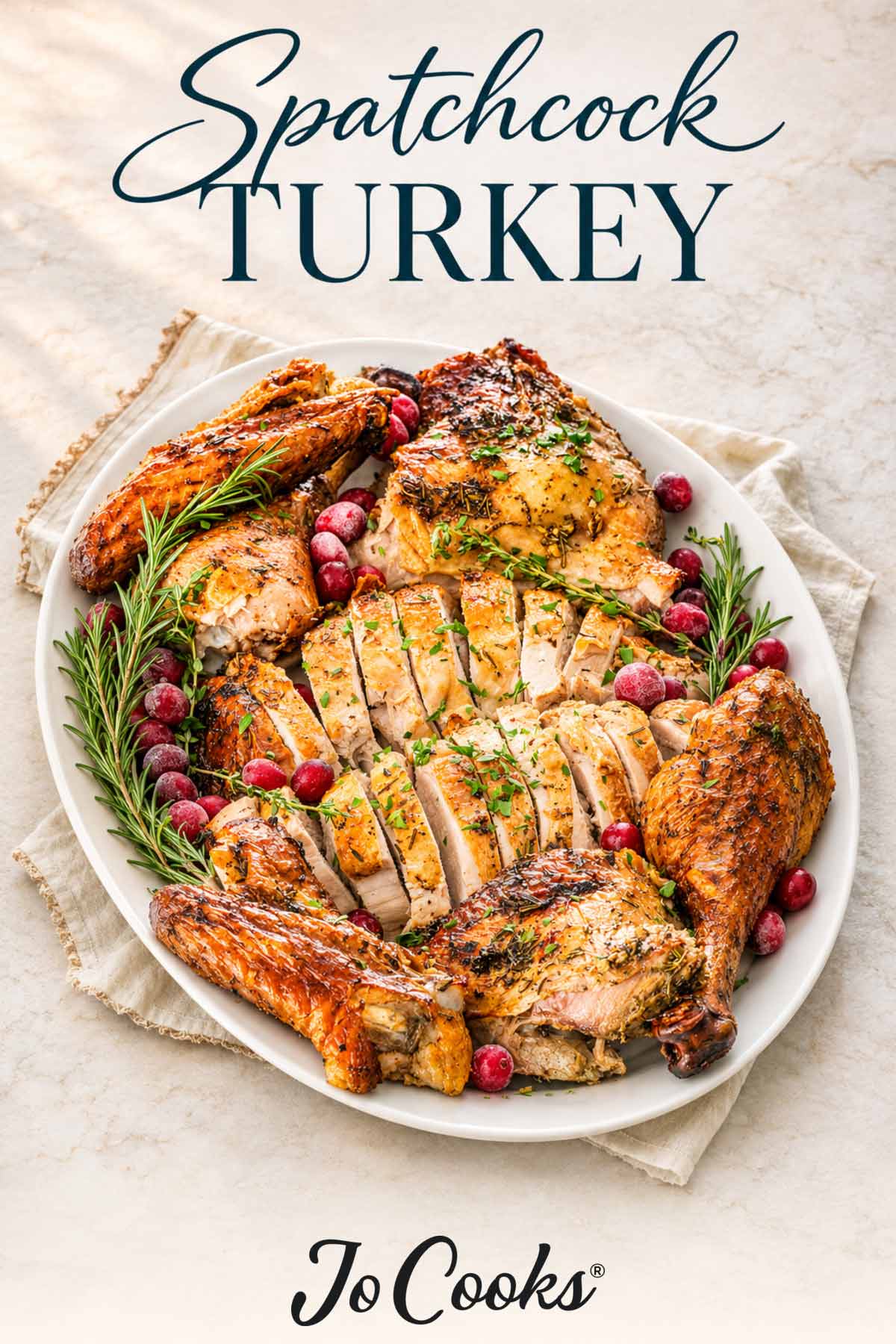
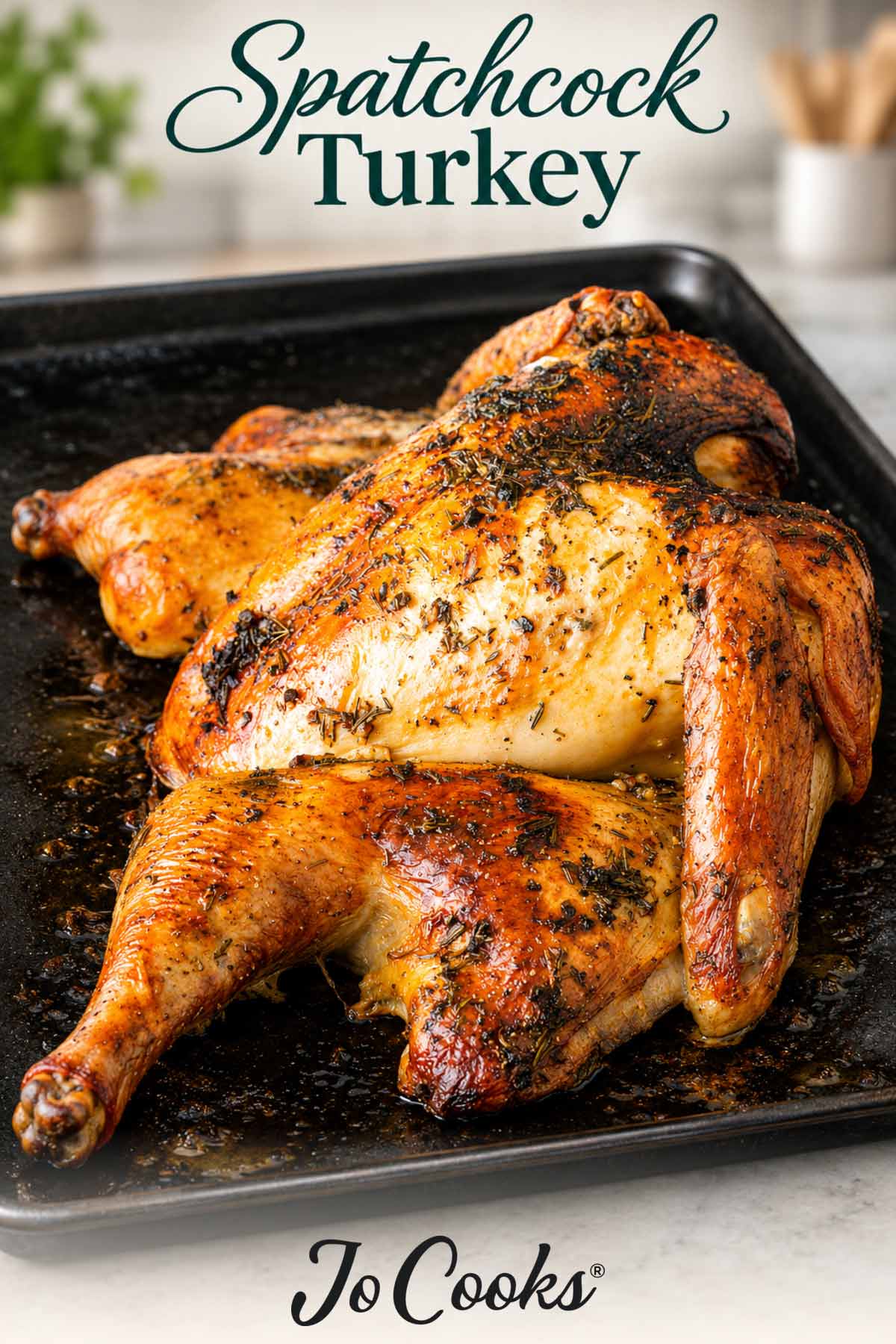
Spatchcock Turkey takes a 12 pound bird from 3½ hours down to 90 minutes. You cut out the backbone, press the bird flat, and the skin goes crisp right across the top while the breast stays juicy. Your oven is free by early afternoon.

Spatchcock Turkey Is The Fastest Way To Cook A Bird
This is probably the easiest and fastest way to cook a turkey, and after enough Thanksgivings I’ve stopped looking for a better option.
You cut the backbone out with kitchen shears, press the bird flat with the heel of your hand, and roast it on a sheet pan. A 12 pounder is done in about 90 minutes instead of 3½ hours, which still feels a bit like cheating.
Flattening it means the breast and the thighs finish at the same time, and that’s the whole problem with roasting a turkey whole. No more dry breast sitting there while you wait for the legs to catch up. More skin faces the heat too, so you get crisp golden skin across the entire bird rather than just the top of it.
And your oven is free by early afternoon, which on Thanksgiving is the actual prize.
What Is A Spatchcock Turkey?
A spatchcock turkey is one that’s had its backbone cut out so the whole bird can be pressed flat. You’ll also see it called butterflying, which is the same thing.
Instead of a tall, awkwardly shaped bird with a hollow cavity in the middle, you end up with something roughly one thickness all the way across, lying flat on a baking sheet.
That shape is what changes everything. A whole turkey is thick in the middle and thin at the edges, so by the time the thighs are safe to eat the breast has been overcooked for half an hour. Flattened, everything sits in one even layer and finishes together.
It also sounds far more complicated than it is. You need sharp kitchen shears and about 5 minutes.
Ingredients in Spatchcock Turkey
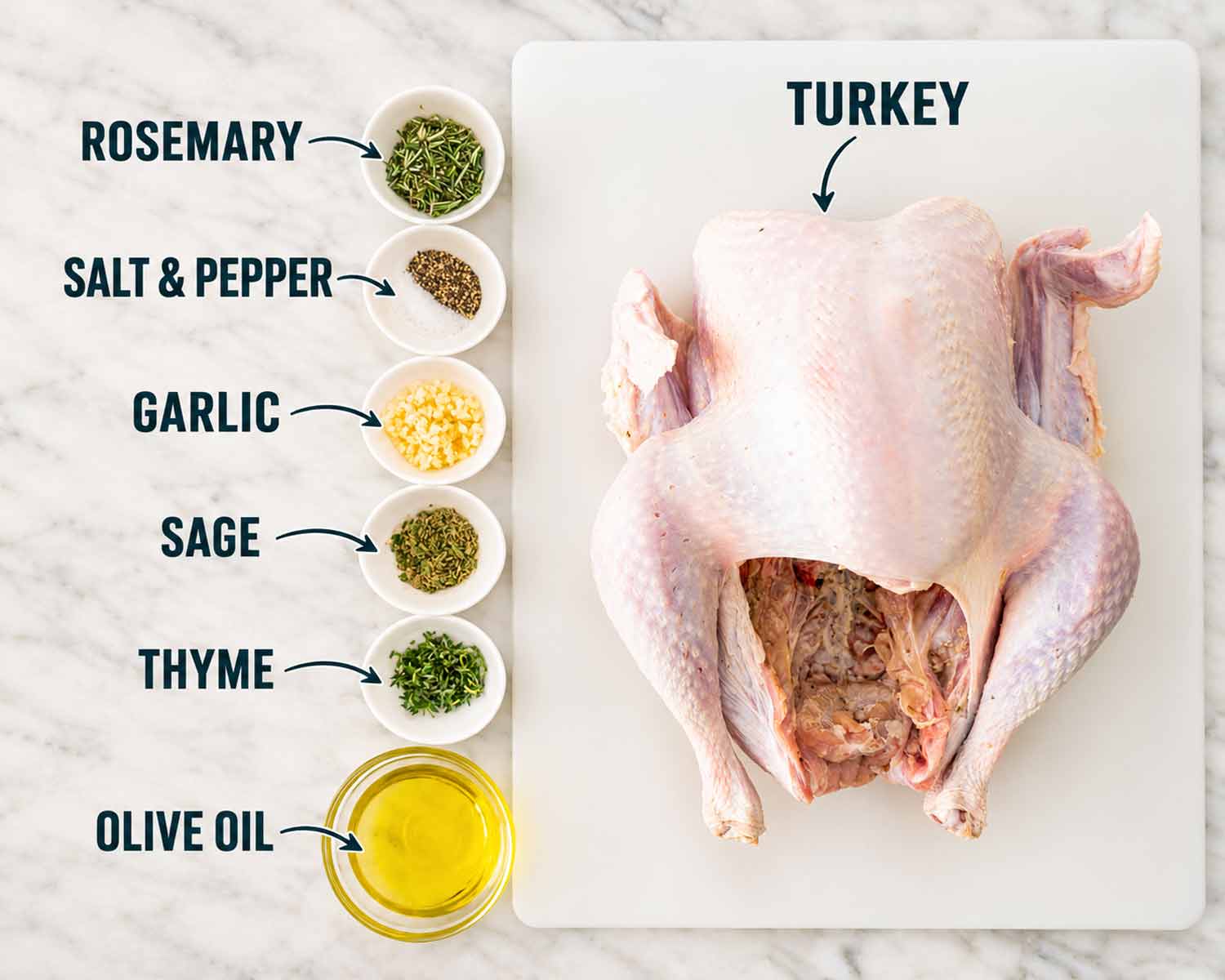
- Turkey (10 to 12 pounds): A smaller bird is better here, because a flattened turkey needs to fit on a baking sheet and in your oven. Anything over about 16 pounds gets unwieldy, and at that point I’d cook 2 smaller ones.
- Olive oil (½ cup): Half a cup sounds like a lot and it’s covering a very large surface area. It carries the herbs and garlic and helps the skin brown.
- Fresh rosemary (2 sprigs), thyme (4 sprigs) and sage (4 leaves), all chopped: Fresh makes a real difference here. Dried herbs in an oil rub tend to scorch at 425°F and taste dusty, where fresh ones stay green and fragrant.
- Garlic (6 cloves, minced): Six cloves for a 12 pound bird is less aggressive than it sounds once it’s spread across the whole thing.
- Salt (1 teaspoon) and pepper (1 teaspoon): Go to taste. I keep the seasoning simple and herb forward, and there’s plenty of room to make it your own.
How To Spatchcock A Turkey
You’ll need sharp kitchen shears. Not the ones in the drawer that struggle with a pizza box. Poultry shears are ideal, and a sturdy sharp knife will do if that’s what you’ve got.
Take out the neck and giblets from the cavity first, and set them aside.

Lay the turkey breast side down with the legs pointing toward you. Cut up along one side of the backbone, straight through the rib bones, then do the same on the other side. The bones crunch and it feels alarming and it’s completely fine.
Lift the backbone out and put it somewhere safe, because you absolutely want it later.
Flip the bird over and press down hard on the breastbone with the heel of your hand. There’s usually a crack, and after that it lies flat.
Snip the wing tips off so they don’t burn.
About that backbone. Don’t throw it out. Roast it alongside the turkey or simmer it into stock, and it makes the best Turkey Gravy you’ll get all year. If you’ve deep fried or bought a breast and have no drippings, there’s No Drippings Gravy too.
Or ask your butcher. They’ll spatchcock it for you in about 30 seconds and they will not find the request strange.
How To Roast A Spatchcock Turkey
Heat the oven to 425°F. High heat is the point, and the flat shape is what lets you get away with it.
Make the herb oil: Mix the olive oil with the chopped rosemary, thyme and sage, the minced garlic, the salt and the pepper in a small bowl.

Brush it on, both sides: Brush the mixture over the inside of the turkey first, then flip it over and brush the outside generously. Get into the creases where the legs meet the body.

Onto the baking sheet and into the oven: Lay it flat, skin side up, and roast for 1¼ to 1½ hours.
Baste every 20 to 30 minutes with the drippings from the pan. This won’t make the meat any juicier, whatever you’ve heard, but it does give you a much more evenly browned skin.
Check the temperature, not the clock. The thickest part of the thigh should read 185°F and the breast should read 165°F.
Rest it for 15 minutes, loosely tented with foil. Carve any earlier and the juices run out onto the board instead of staying in the meat, and then all of this was for nothing.
How Long To Cook A Spatchcock Turkey
About 7½ minutes per pound at 425°F. Here’s how that works out:
| Turkey weight | Roasting time at 425°F |
|---|---|
| 8 pounds | about 1 hour |
| 10 pounds | about 1¼ hours |
| 12 pounds | about 1½ hours |
| 14 pounds | about 1¾ hours |
| 16 pounds | about 2 hours |
That’s roughly half what the same bird needs roasted whole, which is the main reason to do this at all.
Cook to temperature, not time. Ovens lie, birds vary, and a thermometer costs a lot less than the turkey. Thigh at 185°F, breast at 165°F. For reference, 165°F is the USDA minimum for poultry, and taking the dark meat higher is about texture rather than safety, since thighs are full of connective tissue that needs the extra heat to go tender.
Where to put the thermometer: thickest part of the thigh without touching bone, and the thickest part of the breast. Bone conducts heat and will give you a reading that’s higher than the meat actually is.
If the skin browns too fast before the inside is done, lay a sheet of foil loosely over the top and carry on.

Should You Dry Brine A Spatchcock Turkey?
Yes, if you’ve got the fridge space and a day of notice. It’s the single biggest improvement you can make to this turkey, and it costs nothing but planning, which I appreciate is the hardest ingredient to come by in late November.
Salting a bird ahead of time does 2 things. The salt works its way into the meat so it’s seasoned all the way through rather than just on the surface. And sitting uncovered in the fridge dries the skin out, which is what gets you skin that crackles rather than skin that’s merely browned.
It works especially well on a spatchcocked turkey, because the bird is already flat and every bit of skin is exposed to the dry fridge air rather than tucked into a fold somewhere.
The full method, amounts and timing are in my Roast Turkey, which is dry brined. Do that first, then brush on the herb oil and leave out the teaspoon of salt, since the bird will already be seasoned. Everything else stays the same.
How To Carve A Spatchcock Turkey
A flattened bird is easier to carve than a whole one, because everything is already sitting where you can see it.
- Legs first. Cut through the skin between the thigh and the breast, bend the leg back until the joint pops, and cut through it. Then separate the drumstick from the thigh at the joint.
- Then the breasts. Run your knife down one side of the breastbone and follow the ribcage down, keeping the blade against the bone, and the whole breast comes off in one piece. Repeat on the other side.
- Slice the breast across the grain, about ½ inch thick. Across the grain matters more than people think, and it’s the difference between tender slices and chewy ones.
- Wings last, cut off at the joint.
- What you’ll want: a sharp carving knife, a board with a groove around the edge to catch juices, and a pair of tongs. A carving fork if you have one.
Serve the dark and white meat on separate parts of the platter so people can take what they actually want.
What To Serve With Spatchcock Turkey
The full spread, obviously.
- Homemade Turkey Gravy, made with that backbone you kept.
- Homemade Mashed Potatoes and Sausage Stuffing, and the stuffing has to be baked separately here since a spatchcocked bird has no cavity left to put it in.
- World’s Best Cranberry Sauce, which you can make 3 days ahead and forget about.
- Sweet Potato Casserole, Corn Casserole and Quick Yeast Dinner Rolls.
- And The Best Pumpkin Pie or Pecan Pie to finish, in the oven you’ve just freed up.
Storing And Freezing Leftover Turkey
In the fridge, leftover turkey keeps up to 5 days in an airtight container. Carve it off the bones first rather than storing the whole carcass, which takes up the entire shelf.
In the freezer, up to 3 months. Let it cool completely first, then portion it into freezer bags or airtight containers. If you’re using bags, press as much air out as you can as you close the zipper.
Thaw it overnight in the fridge and use it in sandwiches, soup or a casserole rather than trying to reheat slices on their own, which dries them out.
Good places to send it: Leftover Turkey Shepherd’s Pie, Turkey Tetrazzini, and the Leftover Turkey Sandwich I make every single year.

Other Delicious Recipes To Try
Before You Begin! If you make this, please leave a review and rating letting us know how you liked this recipe! This helps our business thrive & continue providing free recipes.

Spatchcock Turkey
Video
Ingredients
- 10-12 pound turkey
- ½ cup olive oil
- 2 sprigs rosemary (chopped)
- 4 sprigs thyme (chopped)
- 4 leaves sage (chopped)
- 6 cloves garlic (minced)
- 1 teaspoon salt (or to taste)
- 1 teaspoon pepper (or to taste)
Before You Begin! If you make this, please leave a review and rating letting us know how you liked this recipe! This helps our business thrive & continue providing free recipes.
Instructions
- Preheat the oven to 425°F.
- Remove the neck and giblets from the turkey. Place the turkey breast side down with the legs towards you. Use a pair of kitchen shears to cut up along each side of the backbone, cutting through the rib bones as you go. Open the turkey out and turn it over, then flatten the breastbone with the heel of your hand, pressing down so that the meat is all one thickness. Cut the wing tips off as well.
- In a small bowl, mix ½ cup olive oil with 2 sprigs chopped rosemary, 4 sprigs chopped thyme, 4 chopped sage leaves, 6 cloves minced garlic, 1 teaspoon salt and 1 teaspoon pepper. Using a brush, brush the olive oil mixture over the inside of the turkey, flip it over and generously brush the outside.
- Place on a baking sheet and transfer the baking sheet to the oven. Roast the turkey for 1¼ hours to 1½ hours, or until the thickest part of the thigh reaches 185°F and the turkey breast reaches 165°F. Baste the turkey every 20 to 30 minutes with the turkey drippings.
- Remove the baking sheet from the oven and cover the turkey loosely with foil. Let the turkey rest for 15 minutes before carving and serving.
Notes
- Use very sharp kitchen shears. It’s important they’re very sharp so you can easily cut through the skin and bones to remove the backbone.
- Don’t throw away the backbone. Use it later for making turkey gravy, or for broths and stocks.
- Use fresh herbs. They make all the difference, and dried herbs tend to scorch at this temperature.
- Baste every half hour or so. Basting won’t make the turkey more moist, but it does promote even browning of the skin.
- Make a compound butter with herbs, garlic and smoked paprika and spread it under the skin for extra flavor.
- Use an instant read thermometer. Cook to temperature rather than time, because ovens vary and birds vary.
- The seasoning here is simple and herb forward, so feel free to play around with other spices or herbs to make it your own.
- Rest the turkey at least 15 minutes before carving. Carve too early and the juices run out and leave the meat dry.
- Leftovers keep up to 5 days in an airtight container in the fridge.
- To freeze, let the turkey cool completely, then put individual pieces into freezer bags or an airtight container. Press as much air out of the bags as you can. Keeps up to 3 months.
Nutrition Information
Notice: Nutrition is auto-calculated for your convenience. Where relevant, we recommend using your own nutrition calculations.
Why spatchcock a turkey at all?
Three reasons. It cooks in about half the time. The breast and thighs finish together so nothing dries out waiting for something else. And far more skin faces the heat, so you get crisp skin everywhere instead of just on top.
Do I need special equipment?
Sharp kitchen shears and a rimmed baking sheet. That’s it. Poultry shears make the job easier but good kitchen scissors will get through a turkey backbone if they’re genuinely sharp.
Can I ask the butcher to do it?
Yes, and it’s a perfectly normal request. Ask them to spatchcock or butterfly it, and ask for the backbone in the bag.
What size turkey works best?
Ten to 12 pounds is the sweet spot. A flattened turkey takes up a lot of surface area, so much past 16 pounds and it won’t fit on a standard baking sheet or in a standard oven. For a big crowd I’d do 2 smaller birds, which still finish faster than one large one.
Can I stuff a spatchcock turkey?
No, there’s no cavity left once the backbone is out. Bake the stuffing separately, which the USDA would rather you did anyway.
Why isn’t my skin crispy?
Usually moisture. Pat the bird properly dry before the oil goes on, don’t cover it while it roasts, and keep the oven at the full 425°F. Dry brining it uncovered in the fridge overnight is the single biggest improvement you can make.
What temperature should turkey be?
165°F in the breast is the USDA minimum and where you want it. The thigh goes higher, 185°F in this recipe, because dark meat has more connective tissue and needs the extra heat to turn tender.
Can I do this on a grill or smoker?
Yes, and a flattened bird is much easier to manage on a grill than a whole one. Indirect heat around 400°F, same temperatures to finish. I haven’t tested exact timings on a grill, so watch the thermometer rather than the clock.
Can I do the same thing with a chicken?
You can, and it’s even easier. I’ve got Spatchcock Chicken here and a Lemon Garlic Spatchcock Chicken over on Craving Home Cooked.